Book in preparation · Springer Natural Computing Series
The Adaptation Stack
Who Learns What, When — from Evolution to AI
Nature runs several channels of adaptation at once, each on its own timescale: evolution across generations, learning within a lifetime, and the slower-than-a-thought but faster-than-a-lineage traffic of social learning between individuals. The book asks one question of that arrangement, and answers it as an algorithm: which channel should carry which information, as a function of how fast the world is changing — and how do the channels steer one another?
Modern AI turns out to have the same stack. Pretraining sits where evolution sits; fine-tuning where development sits; in-context learning where lifetime learning sits; and training one model on another's output where social transmission sits. The question every foundation-model team now argues over — when the world drifts, do you retrain, fine-tune, retrieve, or distil? — is the allocation question, in machine dress.
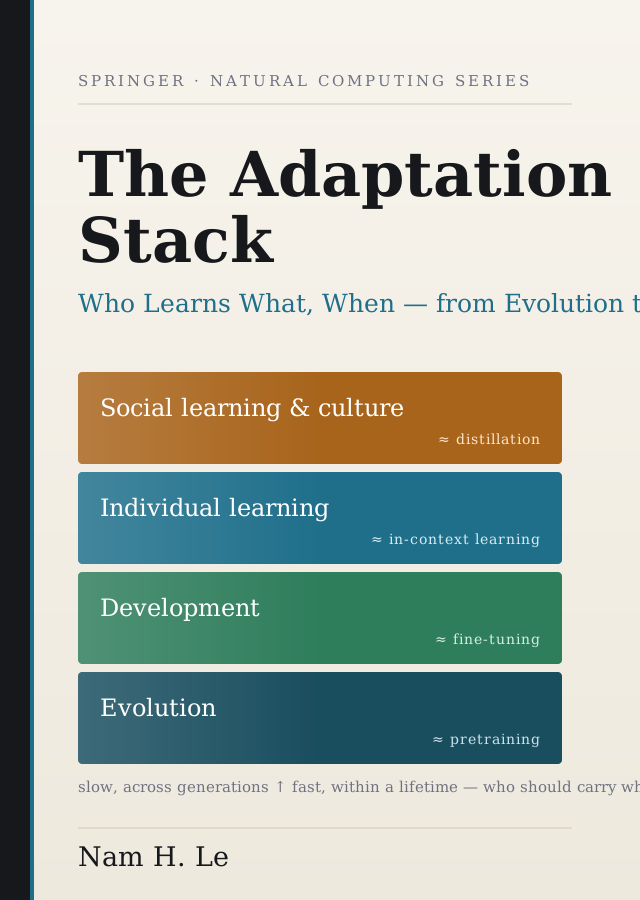
Two stacks, one design problem
The same four layers, named once in biology and once in machine learning:
- Evolution — slow, across generations
- ≈ pretraining
- Development — once, early, then fixed
- ≈ fine-tuning
- Individual learning — fast, within a lifetime
- ≈ in-context learning
- Social learning & culture — between individuals
- ≈ distillation & synthetic data
The lineage the book claims is Dennett's Tower of Generate-and-Test, made algorithmic — not a new identity between evolution and learning, but a theory of the division of labour between them.
What the book argues
Part I
The question
Two stacks set side by side — the one evolution built and the one machine learning has assembled — and a single design problem stated plainly: which layer should carry which information, and when.
Part II
The layers, in theory
A chapter each for the slow layer (selection), the fast layer (learning) and the social layer (transmission): what each is, what it costs, and the first result about two of them steering one another — the Baldwin effect, read as an engineering condition rather than a historical curiosity.
Part III
Allocation in silico
What my own experiments, and the literature, say about the allocation problem: the rate at which the world changes decides which layer wins, the rules hold across substrates, and they hold even when the environment is another adapting agent.
Part IV
What machines may do that life cannot
Three freedoms a machine stack has and biology does not — writing its own objective, writing information back down the stack, and setting its own price — and where the same questions now land for foundation models under drift.
Where it comes from
The book grows out of my doctoral work on learning and evolution and extends, through the papers below, to the dynamics of foundation models. Each is one layer of the argument; the chapters that rest on work still under review are described here only in outline.
- Learning and evolution (PhD) Self-taught neural networks across dynamic, rugged landscapes — the empirical ground for the allocation question. Code
- Emergent collective reproduction (VitaNova) Northeast Journal of Complex Systems, 2025. Paper
- Decoupling representation and learning (LaSER) Genetic Programming Theory & Practice XXII, Springer, 2026. Preprint
- Phenotype-first evolution (Phenopoiesis) Information flowing down the stack. Preprint, 2026. Preprint
- Model collapse as Rogers' paradox The economics of copying, carried over to language models. Preprint, Zenodo, 2026. Preprint
- Relational reasoning under implicit selection (Oddworld) When a stack sets its own objective. Preprint, Zenodo, 2026. Preprint
Status
A full monograph, in preparation for Springer's Natural Computing Series; the proposal and sample chapters are being written. If you edit for the series, or would like to read a chapter in draft, I would be glad to hear from you — namlehai90@gmail.com.